Originally posted October 28, 2023
As first time parents, especially when neither of us had worked in childcare, we were pretty clueless when it came to developmental milestones. In some areas, our firstborn was very intelligent: he could repeat anything you said almost verbatim, he knew the names of most animals and he knew his alphabet at an early age. But he struggled in other areas: he couldn’t answer questions or hold a conversation instead he would repeat what you asked or quote a line from a movie, he didn’t “pretend play” like his peers but preferred to line up his toys or dump them out in piles and roll on them, and he wouldn’t play “with” his peers but alongside of them in his own world. By the time we brought up our concerns to his pediatrician, he had almost aged out of the Early Intervention program.
When our second child came along, I was more aware of language/communication expectations and could tell that our daughter was speech delayed. By the age of 2, even as her parents, we still really struggled to understand her words. She was very vocal but difficult to understand. We started using a homemade picture book to help with mealtimes. We were frustrated and so was she. Thankfully, because I now knew about Early Intervention, I was able to call in a parental referral and get her evaluated at 24 months. She qualified for therapy solely in communication.
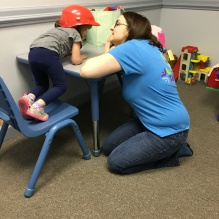
As a final example, we requested an evaluation for our youngest child twice. First, when she was a newborn our youngest was diagnosed with torticollis and would need physical therapy. The evaluator determined that since the torticollis was not inhibiting her physical needs, Early Intervention was not necessary and so we were denied. But later, when we were really struggling with her bedtime we knew there was some sort of sensory processing issues going on. So after another evaluation (at least 1.5 to 2 years later) it was determined that our youngest did indeed have Sensory Processing Disorder and would receive Occupational Therapy in our home.
What is Early Intervention?
Early Intervention is a State funded program for children newborn until their third birthday. It provides developmental testing and therapies if recommended in several areas including Cognitive Development, Gross Motor Skills, Fine Motor Skills, Receptive and Expressive Communication, Social and Emotional Development and Independent Living Skills. The Infant & Toddler Connection of Virginia defines Early Intervention services as “for infants and toddlers who are not developing as expected or who have a condition that can delay normal development, and their families.”
As a parent or guardian, you are able to call in a referral yourself without waiting for a professional. They will schedule a time for an evaluator to come to your home to complete a full evaluation with your child (and you). Some questions are developmental that you as a parent or guardian will have to answer and others will be task oriented to determine the child’s skill level. It is also helpful to have a list of behaviors and concerns that you would like to address with the evaluator. Following this process, you will be informed if your child qualifies for therapies. We have had both a therapist come to our home and have received therapy as an outpatient at a clinic.
In case I have not stated earlier, this is a FREE service. They are required to apply your insurance, but any copays or fees will be covered by the State until your child’s third birthday.
You can contact your local Behavioral Health Dept or call the direct number in Richmond, VA at (804) 786-3710 or toll free at 1-800-234-1448 to reach the Central Directory.
What Happens After the Child Turns 3?
Because Jackson was already so close to turning 3 when we brought our concerns to his pediatrician, he was referred to the County’s Early Intervention Preschool program. The public school system had an application and evaluation process to be accepted into the EI Preschool. With his autism diagnosis and his developmental delays, our son was accepted into the program. He attended the EI Preschool until his graduation to Kindergarten.
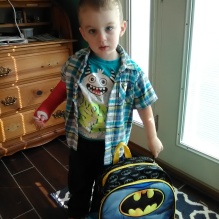
With our second child, he case worker kept track of her birthday and informed us when she was getting ready to age out of the State’s Early Intervention program. We were given the option to forward her information to the public school system and apply for the Early Intervention Preschool like her brother. The case workers provide a seamless process to go from one program to the next if desired.
Having access to these resources is a HUGE blessing!!! I remember when Jackson received his autism diagnosis and was accepted into the Early Intervention Preschool it was a huge weight lifted off of me. I knew I wasn’t crazy and I knew I wasn’t alone anymore. I had teachers and therapists coming alongside of me to help me understand my child’s needs and reassure me that my feelings were valid too. I cannot express the relief that having help for each of my children’s specific needs provided for us as a family.
Until next time …
 Coffee, Swings & Dinosaurs