As I continue to write posts, I will try to tag many of them so that they will fall into three major topics listed on my homepage: Therapies, Autism Corner and Homeschooling. That way if you want to focus on a certain topic you can just click into it. Of course, not all of my posts will be limited to those topics. Life is so much more than that!
So here’s to my crazy, messy life . . . with coffee and dinosaurs!
As first time parents, especially when neither of us had worked in childcare, we were pretty clueless when it came to developmental milestones. In some areas, our firstborn was very intelligent: he could repeat anything you said almost verbatim, he knew the names of most animals and he knew his alphabet at an early age. But he struggled in other areas: he couldn’t answer questions or hold a conversation instead he would repeat what you asked or quote a line from a movie, he didn’t “pretend play” like his peers but preferred to line up his toys or dump them out in piles and roll on them, and he wouldn’t play “with” his peers but alongside of them in his own world. By the time we brought up our concerns to his pediatrician, he had almost aged out of the Early Intervention program.
When our second child came along, I was more aware of language/communication expectations and could tell that our daughter was speech delayed. By the age of 2, even as her parents, we still really struggled to understand her words. She was very vocal but difficult to understand. We started using a homemade picture book to help with mealtimes. We were frustrated and so was she. Thankfully, because I now knew about Early Intervention, I was able to call in a parental referral and get her evaluated at 24 months. She qualified for therapy solely in communication.
Outpatient Speech Therapy
As a final example, we requested an evaluation for our youngest child twice. First, when she was a newborn our youngest was diagnosed with torticollis and would need physical therapy. The evaluator determined that since the torticollis was not inhibiting her physical needs, Early Intervention was not necessary and so we were denied. But later, when we were really struggling with her bedtime we knew there was some sort of sensory processing issues going on. So after another evaluation (at least 1.5 to 2 years later) it was determined that our youngest did indeed have Sensory Processing Disorder and would receive Occupational Therapy in our home.
What is Early Intervention?
Early Intervention is a State funded program for children newborn until their third birthday. It provides developmental testing and therapies if recommended in several areas including Cognitive Development, Gross Motor Skills, Fine Motor Skills, Receptive and Expressive Communication, Social and Emotional Development and Independent Living Skills. The Infant & Toddler Connection of Virginia defines Early Intervention services as “for infants and toddlers who are not developing as expected or who have a condition that can delay normal development, and their families.”
As a parent or guardian, you are able to call in a referral yourself without waiting for a professional. They will schedule a time for an evaluator to come to your home to complete a full evaluation with your child (and you). Some questions are developmental that you as a parent or guardian will have to answer and others will be task oriented to determine the child’s skill level. It is also helpful to have a list of behaviors and concerns that you would like to address with the evaluator. Following this process, you will be informed if your child qualifies for therapies. We have had both a therapist come to our home and have received therapy as an outpatient at a clinic.
In case I have not stated earlier, this is a FREE service. They are required to apply your insurance, but any copays or fees will be covered by the State until your child’s third birthday.
You can contact your local Behavioral Health Dept or call the direct number in Richmond, VA at (804) 786-3710 or toll free at 1-800-234-1448 to reach the Central Directory.
What Happens After the Child Turns 3?
Because Jackson was already so close to turning 3 when we brought our concerns to his pediatrician, he was referred to the County’s Early Intervention Preschool program. The public school system had an application and evaluation process to be accepted into the EI Preschool. With his autism diagnosis and his developmental delays, our son was accepted into the program. He attended the EI Preschool until his graduation to Kindergarten.
First Day of Early Intervention Preschool
With our second child, he case worker kept track of her birthday and informed us when she was getting ready to age out of the State’s Early Intervention program. We were given the option to forward her information to the public school system and apply for the Early Intervention Preschool like her brother. The case workers provide a seamless process to go from one program to the next if desired.
Having access to these resources is a HUGE blessing!!! I remember when Jackson received his autism diagnosis and was accepted into the Early Intervention Preschool it was a huge weight lifted off of me. I knew I wasn’t crazy and I knew I wasn’t alone anymore. I had teachers and therapists coming alongside of me to help me understand my child’s needs and reassure me that my feelings were valid too. I cannot express the relief that having help for each of my children’s specific needs provided for us as a family.
Every person has a unique make up of how their body takes in sensory stimulii, the brain translates it into a message and sends it out. But for some people, the wires of communication work faster or slower, take detours or short-cuts and sometimes even the brain misunderstands the messages and sends out the wrong reaction. This is called Sensory Processing Disorder. Sensory Processing Disorder is a common comorbidity with Autism and ADHD but can sometimes stand alone.
The different sensory needs are as follows: – Sight – Hearing – Touch – Smell – Vestibular – Interoception – Proprioception
There are so many children who have different sensory needs. One of the biggest reasons I want to open an indoor playground is to help alleviate these needs for local families. So below I want to introduce the major sensory processes and explain them briefly. Because of our own experiences at home, I can give greater insights into certain sensory needs, while I’m sure you may be more aware of others due to your own experiences.
Sight
Some of these sensory needs are fairly easy to understand but I wanted to break down how they can be understimulated or overstimulated. A person who gets easily overstimulated by visual information doesn’t like bright lights, sunshine, flashing lights and may require sunglasses in enclosed buildings or likes to hide in dark spaces. As a mother, I become so easily overstimulated visually because my son will find a YouTube video he is excited about and shove it in my face to see! This is one of my biggest triggers with my kids!! Being understimulated will cause the person to seek out bright flashing lights, bright TV shows and may stand up close to the TV or tablet screen as much as possible.
Hearing
Those who are overstimulated with sounds prefer the use of Noise Cancelling Headphones or like to use the noise filtering ear plugs like Loop. You can easily spot these struggles in noisy bathrooms with automatic flushing toilets and powerful hand dryers, noisy store environments, noisy streets, large crowds, etc. My kids would immediately cover up their ears and cry and shake. We have invested in several pairs of Noise Cancelling Headphones to help us navigate long road trips and shopping days. On the flip side, there are people who CRAVE the loud noises and need that extra stimulation. I remember my younger years of blasting heavy rock into my CD walkman headphones throughout the day. The loud beats and rhythms were very soothing for my stressed nerves in high school.
There are also some strange variations that can occur within the hearing sensory needs: volume may not be the only sound irritant. Complexity of sounds may also trigger overstimulation. Restaurants are notorious for this. All the loud clanging and talking background noises can be overwhelming to those whose brains are unable to filter out the sounds like most “neurotypical” people. And then to use all your extra senses to compensate: trying to focus to read lips and watch body language is exhausting. This may also explain why some people avoid the loud environments mentioned above but blast their personal music in their own spaces. The beats and rhythms are timed and expected whereas the chaotic environments are unpredictable and jarring.
Noise Cancelling Headphones
Touch
Touch or tactile. This one can also be very complex. There are so many different forms of tactile information that some are wanted and others abhorred. Some people love the sticky, messing feeling of paint, play-doh, slime, glue, bubbles, shaving cream, etc. Others will avoid it at all costs! I have one child that will be covered from head to toe in paint and another that will demand to be wiped off immediately if a speck gets on his finger.
Meanwhile, the same child who hated the sticky messes, would constantly dump out his basket of toys and roll around in them, step on and crawl through his PILES of toys just to satisfy his need for extra stimulation. He would create huge piles of blankets and stuffed animals and crawl underneath for the extra weight and pressure. My kids love to have their souls squished and squeezed out of them with bear hugs or couch smooshes!! For the past few months my son has started to pile up thick blankets on top of him to help him go to sleep at night. He prefers to be cold so its not the warmth he’s seeking, its the weight and pressure to help him go to sleep.
Smell
Smell or olfactory. We could probably squeeze gustatory into this one as well. This makes me think of all the candle aisles and wax melts, the wonderful smells of bakeries, and pungent chemical smells on unexpected toys. Some people can be extra sensitive to smells, my son will make a face and demand to know what he’s smelling. I have recently discovered he is not a fan of my favorite moisturizing hand lotion. Ugh.
Gustatory (taste) sensitivities effect food tolerances. A common complaint of parents is that their kids are “picky eaters.” But this actually runs much deeper than a taste preference. Certain textures and tastes can actually trigger gagging and vomitting. My son will almost always refuse a soft, mushy food, like yogurt or applesauce. Some taste sensations are so sensitive that the person can detect a different brand, marinade or cooking convention. There’s also a popular meme floating around Facebook that perfectly explains why someone would choose an unhealthy alternative (say cracker) to a fruit or vegetable: texture and taste is reliable and consistent. They can trust the cracker to always have the same taste and crispness whereas the fruit might be firmer or mushier, sweeter or sour.
There’s also an eating disorder called Pica where the child eats non-food items: dirt, chalk, grass, toys, etc. Sometimes this is caused by a nutrition deficiency, but it can also be the need for oral stimulation. My first two children didn’t really put any toys in their mouths, but my youngest needed intense feeding therapy to learn how to properly suck as an infant and desensitize her gag reflex. So after being used to having to chew on teethers all the time, she continued to chew on EVERYTHING well long after therapy. There are now so many durable chew toy options for these needs. Also, offering crunchy foods, sucking smoothies through straws and chewing gum can help too.
Vestibular
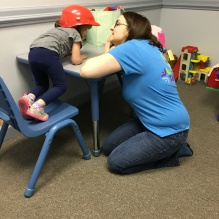
Vestibular relates to the inner ear and balance. This one isn’t as commonly known, but those who struggle with this particular stimulation love to swing and spin. When you see a child spinning in circles over and over again, its giving them the sensation of their place in the world. It could also be providing visual stimulation with the constant moving motion. As we started to transition our youngest to sleeping in her sister’s bedroom, it took a full one to two hours for her to scream and finally calm down for bedtime. It was emotionally and physically exhausting for us as parents and who knows how troubling and disorienting for our daughter. This was our greatest need for an Occupational Therapy evaluation for her. She didn’t know how to communicate this sensory need and all she could do was scream. So very heartbreaking. The need? Vestibular. We purchased and installed a sensory swing. I gave her time to swing before bedtime every night, sometimes singing to her, sometimes she just wanted silence. Over time her routine has morphed into starting with jumping on the bed while singing “3 Little Monkeys Jumping on the Bed” and then swinging while I sing “Little Bunny Fufu.” When I call out “the end!” she’s ready to hop out and lay down for bed. What a difference it makes when we take the time to figure out what sensory needs our children have and to provide for them!
Interoception
Another not so well known system is Interoception. This is when the body struggles to communicate or overcommunicates its needs that include toileting, hunger, hydration, gauging temperature and feeling one’s own emotions. Growing up and now into adulthood, I can tell you that I was very hyper sensitive of my body’s functions. So much so that I would complain about maladies before any doctor could detect or test for it, which caused and still causes a lot of frustration for me.
Most of my children seem to be more hyposensitive. We’ve really struggled with our daughter being able to recognize when she is hungry. We’ll ask her what she would like to eat for lunch but she’ll respond she doesn’t want anything. Over an hour has passed, we’ve moved on to different activities and she’s now ready to eat! As you can imagine, this causes a lot of disruption in our day and forces us to be very flexible with our home routines. The opposite is also possible, where the person’s body won’t communicate when its full causing overeating. The same child also has had significant trouble recognizing when she has to potty. This is why forcing an arbitrary timeline on skills is not at all beneficial. A person’s body may not be able to effectively communicate the need in time until it has matured in that area. Another one of my children is extremely intolerable to heat and will become overwhelmed very quickly out in full sun.
Proprioception
Lastly there is Proprioception. This comes from the internal sense relating to the joints, muscles, ligaments and other connective tissues. The biggest indicator for this is when you watch a person constantly bump into their peers or trip and fall all the time. Their body is not sensitive enough to communicate how close they are to something or someone. Many children could be wrongly labeled “aggressive” when it is just their body lacking the ability to communicate its surroundings. These needs are assisted with jumping, crashing, pulling, and pushing. These activities are referred to as “heavy lifting.” Unfortunately many people are under the impression that removing free activities like recess as a punishment will help with outbursts and poor behavior but in actuality it compacts the problem exponentially.
When we were struggling with understanding our youngest’s sensory needs a year or two ago, her Occupational Therapist suggested ankle weights because my daughter demanded to go to bed with her shoes on for the longest time. Her OT explained that for some children, their bodies cannot interpret their place in space and feel like they’re almost floating in air!! So the extra weights actually helped them feel like they were anchored to the floor and relieved a lot of their anxiety!
In Conclusion
As you can see, understanding sensory processing needs and providing ways to avoid them or amplify them can make life so much more tolerable and enjoyable for those who struggle with this disorder. We have been blessed to be able to provide some sensory equipment for our children at home. But having a much larger area with greater outlets for energy and exuberance would be even better!
As you read these sensory processing needs and recognize them in your own families and friends, pray for God’s provision in this endeavor!! I hope that we can assist our community with these specialized needs!
I have been wanting to share about Jackson’s handwriting experience for a long time now. This was our (both mine and John’s) biggest concern for Jackson going into kindergarten. We worried that without extra time and attention, he would not be able to keep up with the other kids in his class (he was supposed to enter a regular kindergarten classroom) and soon become discouraged and depressed. And where discouragement comes, absolute refusal soon follows.
I had also already seen in one of his Pre-K classrooms that his teachers were unable to MAKE him do an activity if he didn’t want to do it. I needed to make sure that his handwriting was something that he practiced everyday. Now granted, I could have spent the extra time at home with him after school to practice his handwriting, but that soon would become tedious work during his much-needed down time. And I found that during the COVID shutdowns it was extremely hard for me to follow someone else’s lesson plans.
Can I just say how THANKFUL I was that we had made the decision to homeschool well in advance so that I had time to process, carefully pick out curriculum and prepare myself for the daunting task. When the COVID hysteria carried on into the next year, I couldn’t imagine having to make such an important decision so abruptly. And to even think how it would have been had we kept him in school with ever changing schedules and routines, and required to wear a mask! That’s too much to ask for a special needs child, much less any child!
How Did We Tackle Handwriting?
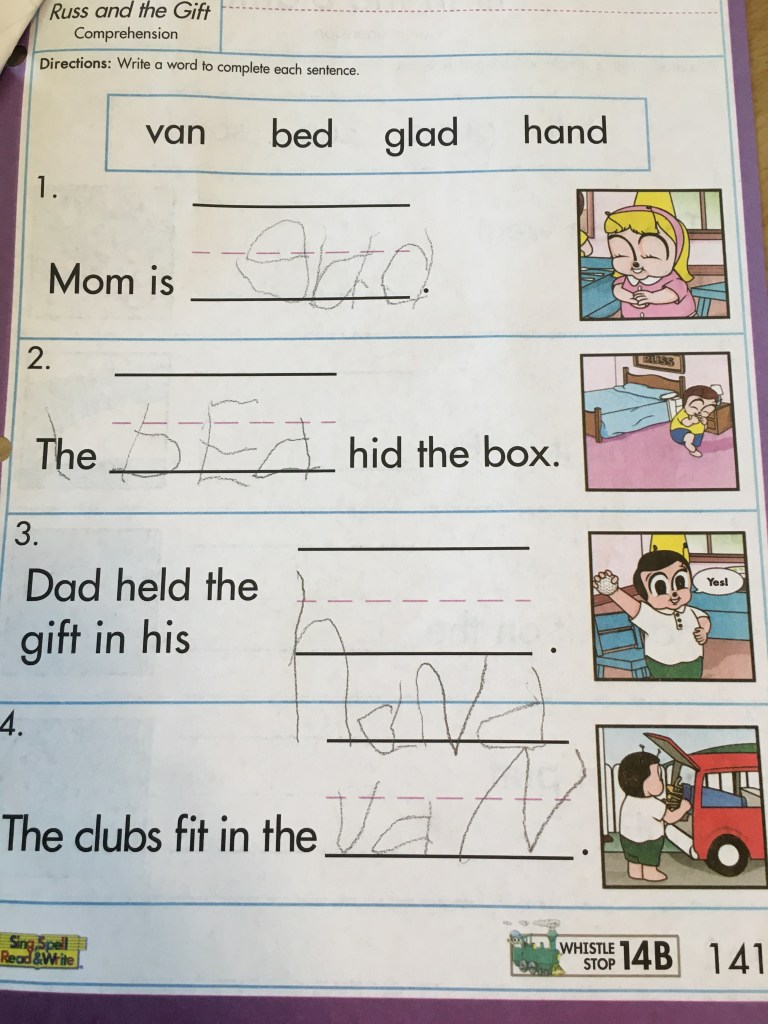
Growing up my mom used the Sing, Spell, Read and Write curriculum so I wanted to use it with my kids. To this day I can remember the songs that we sung to help us practice our vowels and blending sounds. But I soon discovered that for Jackson, practicing his handwriting was extremely stressful and frustrating. I could barely get him to finish an entire page of tracing letters. He always demanded me to help him (which meant me leaning over him holding onto his hand while he held onto the pencil). And his letters were still reversed and confusing to read. So what could I do to make this easier???
In several of my homeschooling groups on Facebook, I had seen this curriculum called Handwriting Without Tears being used a lot. I always thought that the title was a bit ostentatious. But I decided to take a look at it. This program actually used several different forms of manipulatives to help the student feel and learn the shape of the letter…correctly. I especially appreciated how there were verbal instructions that were simple, repetitive and often in song form. So I took the plunge and purchased a new curriculum mid-year!
Hands-On Learning to the Rescue!
I try as much as possible to use hands-on learning for my kids. So wouldn’t it make sense that their handwriting instruction incorporated that too? YES!!! When I ordered a kit for 1 student, it contained a set of blocks for capital letters, a small chalkboard, a foam mat, tiny sponges, chalk pieces and short pencils. The teacher’s manual provides several games to get the kids comfortable with the blocks and the terminology used with them. Some games provide spatial awareness. I didn’t want to spend a lot of time on the games because I knew that Jackson would get bored with them quickly. But I will probably use them quite a bit next year with Angela.
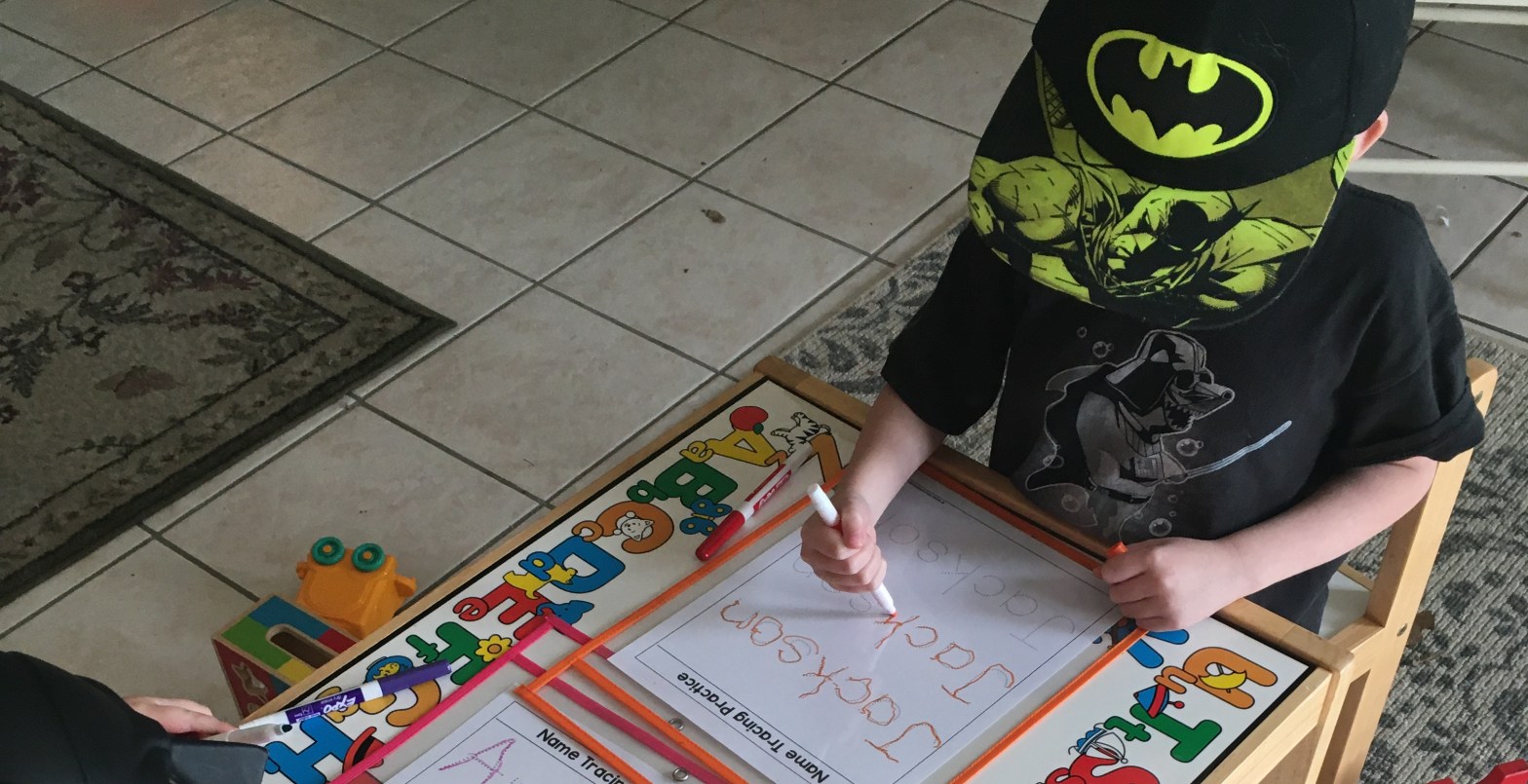
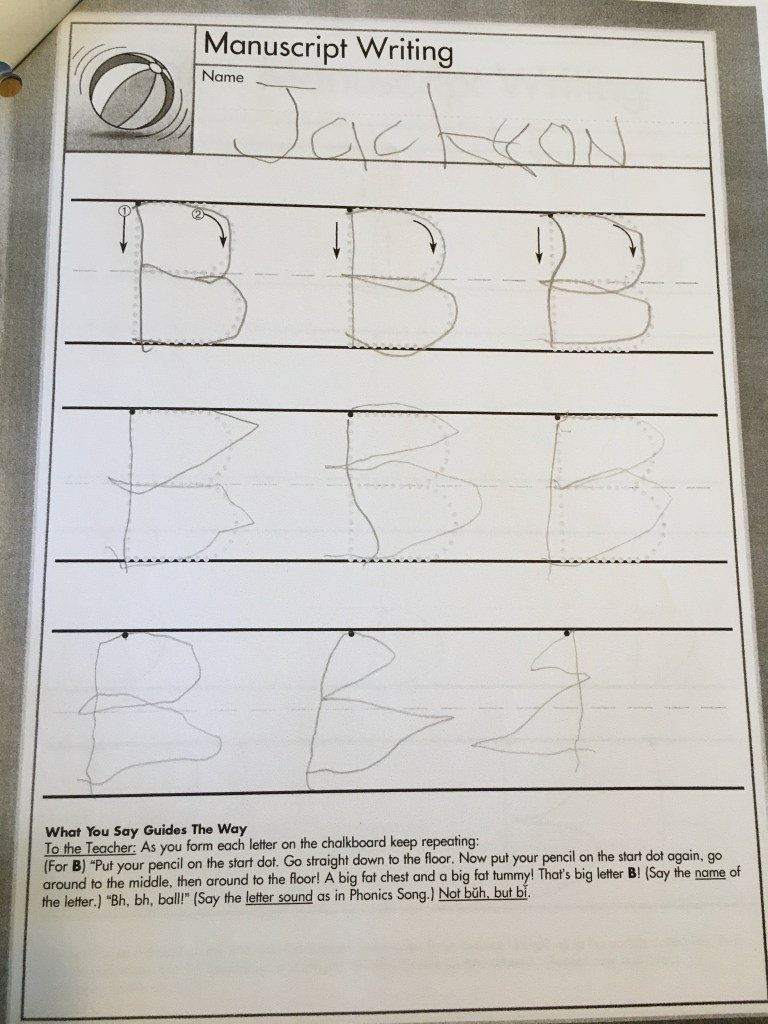
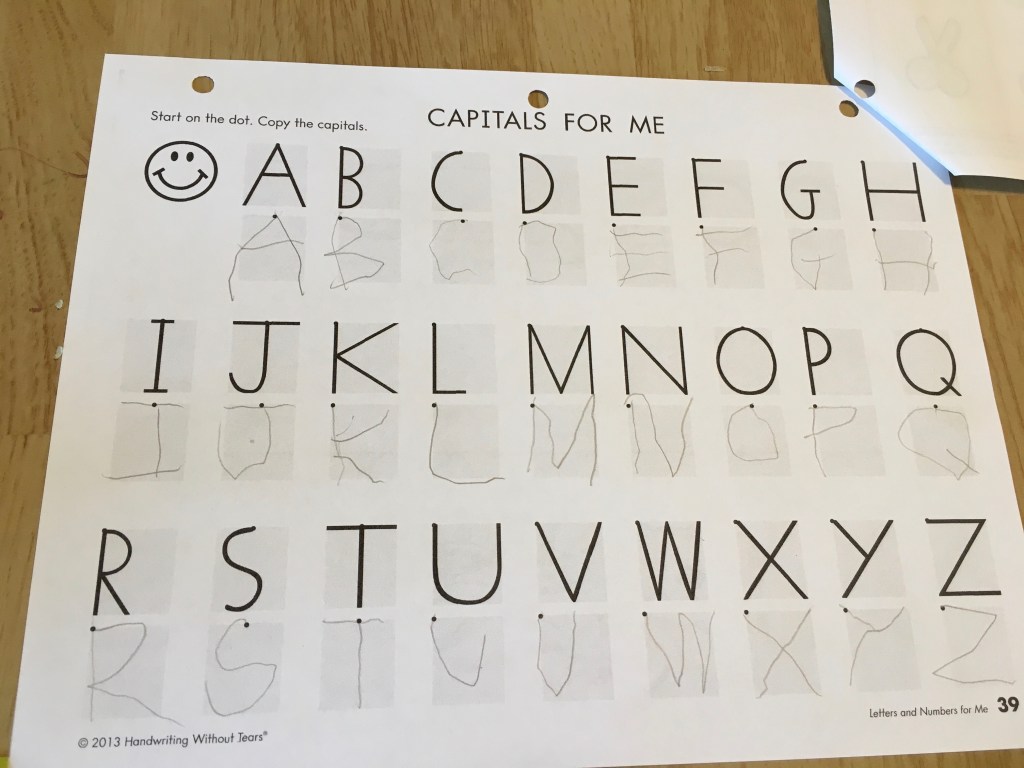
This program starts with only the capitals because they have the simplest strokes and are the same size. The kids LOVE singing and dancing to the songs that focus on specific strokes. Then I’ll guide them with specific phrases to make the capital letter with the wooden blocks and then with the chalkboard. After that comes actual paper and pencil. By this time, Jackson is eager to try out the specific strokes himself!! I may need to guide him in the beginning for a new letter, but he actually fusses at ME because he wants to do it!! You can see the difference in the picture below. Jackson wrote all the letters independently.
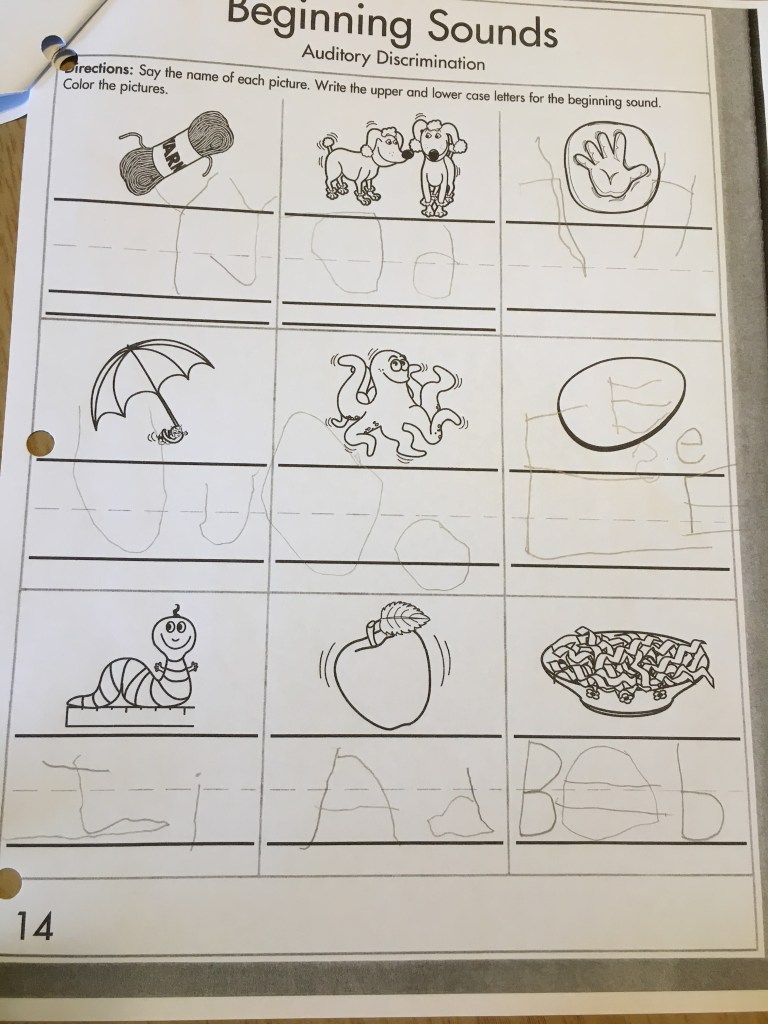
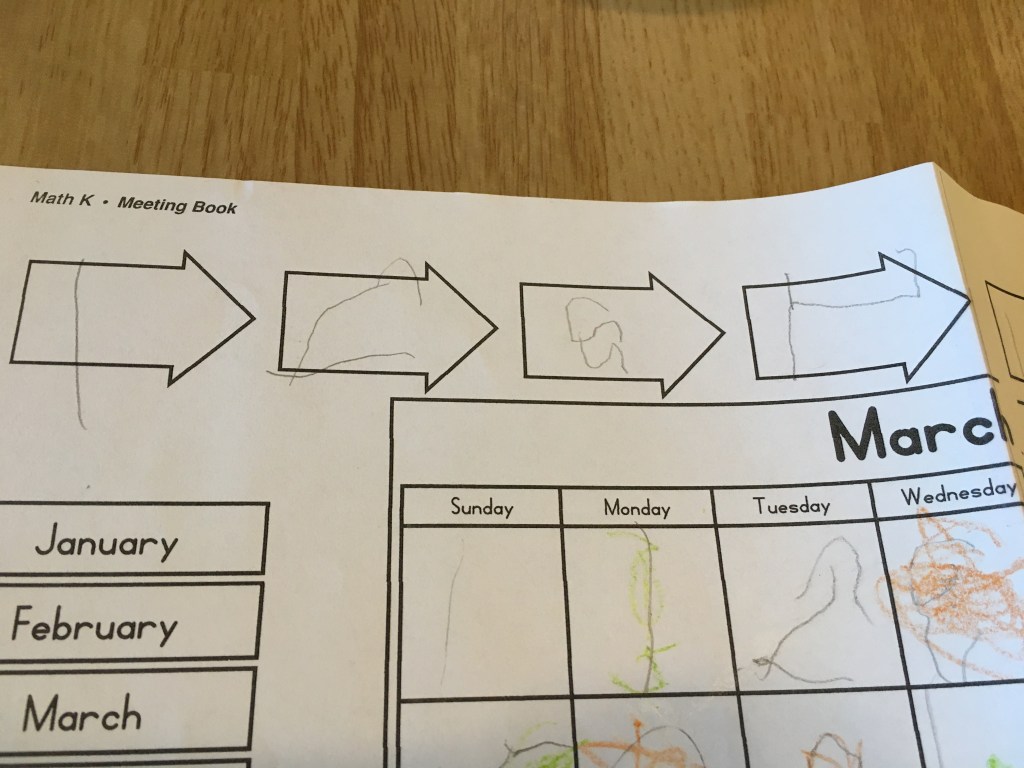
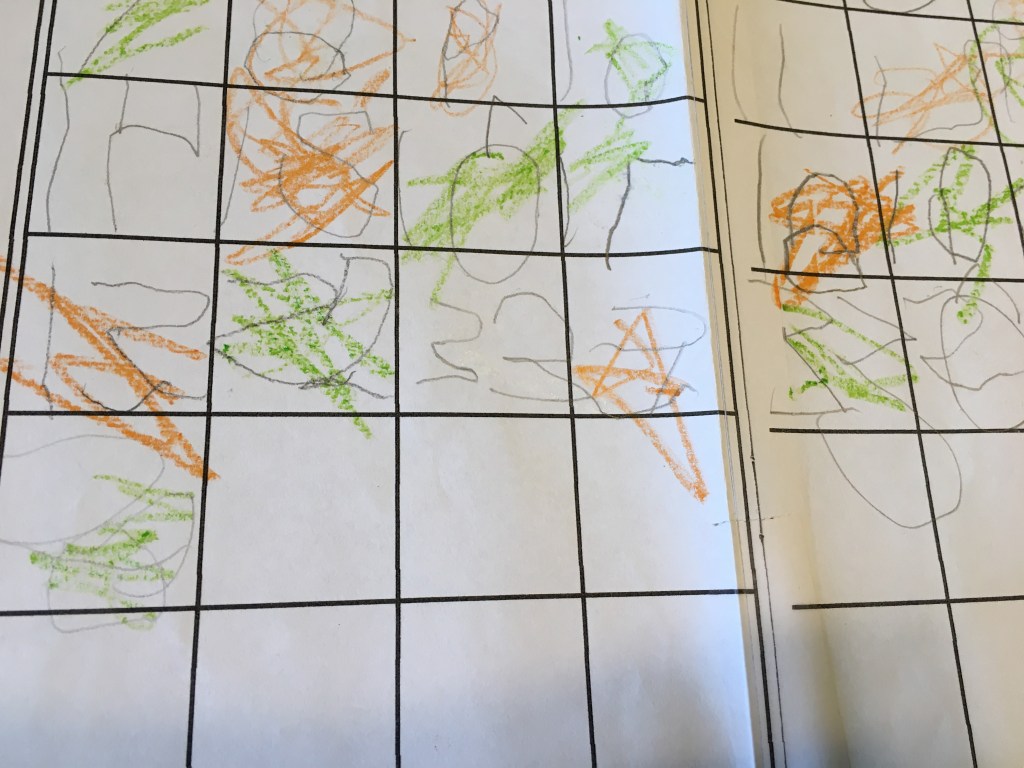
Instead of following the program’s layout, I continued Jackson onto numbers instead of the lowercase letters because his numbers were almost unrecognizable. And he uses them a lot for his math, of course. We just finished going through numbers 1 – 10. You can see the difference within one calendar month below.
I am so grateful and so pleased that I switched Jackson to this new program. His handwriting has made incredible improvement! And I can’t wait to continue on to lowercase letters, to see his improvement there and also just to see his confidence and precision continue to increase overtime.
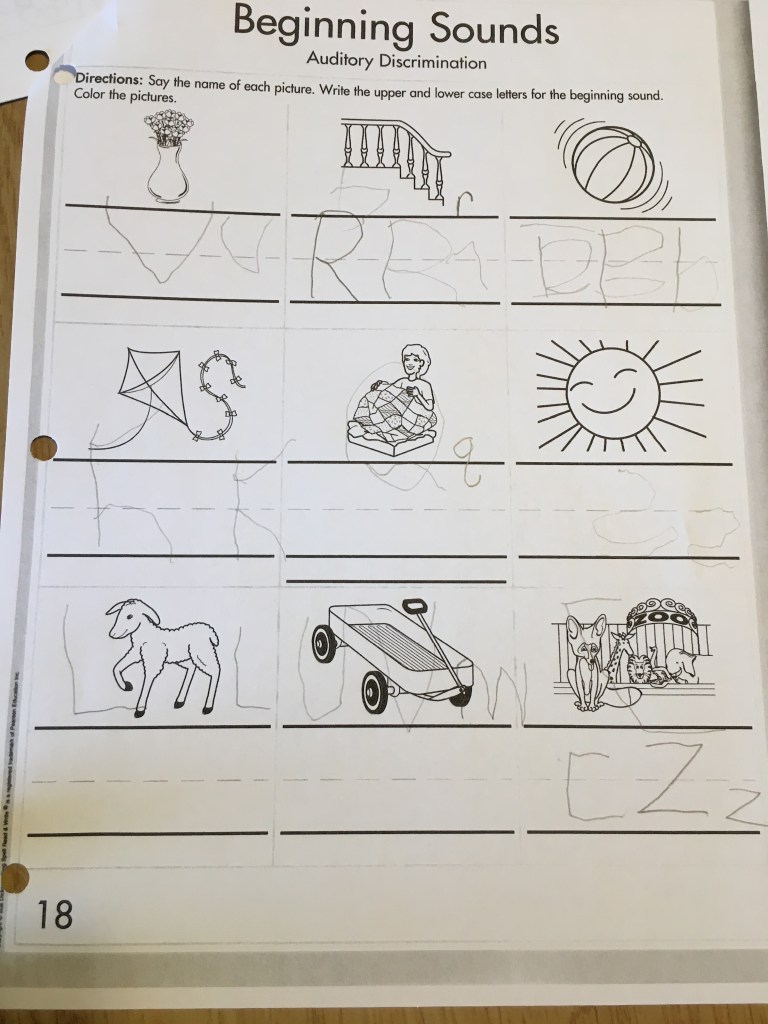
Below is his overall improvement from the beginning of the year to now. You can also notice where his pressure (the lines are darker) has improved too. That was something he really struggled with, too, because of his poor fine motor skills.
This year has been extremely hard for me, but as it is coming to close I have so much to be thankful for. John and I decided to test out the housing market to see if we could sell our home in Tennessee and move closer to John’s work across the border in Virginia. Within 2.5 weeks we had a contract on our home and closed the sale and purchased our new home on October 30th. Whew!!! It certainly was a crazy, stressful time! But now John’s commute to work has shrunk from 40 minutes to just over 10! And our new home is PERFECT for us! There is so much more living space and storage, it has everything that we wanted. We are very blessed.
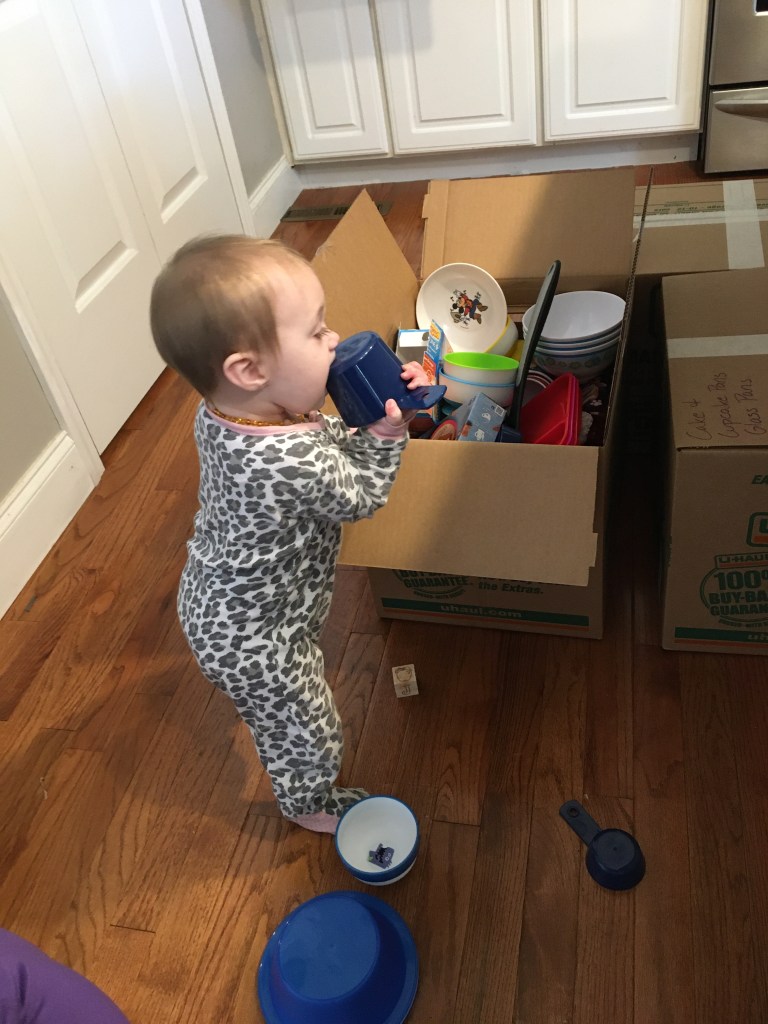
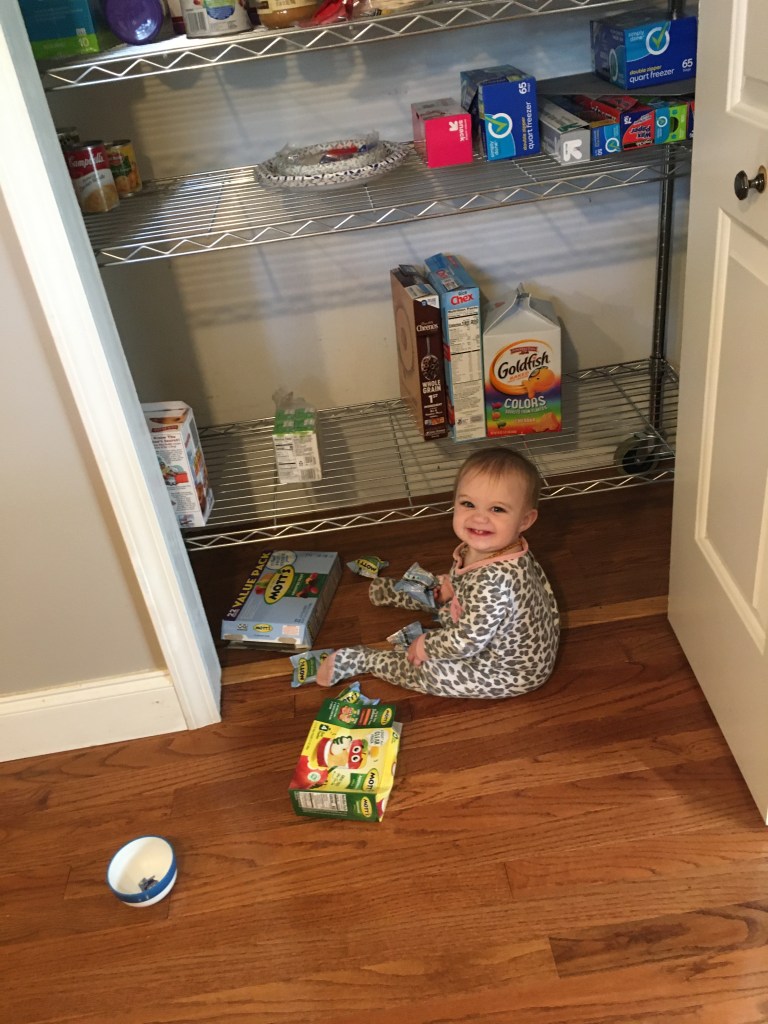
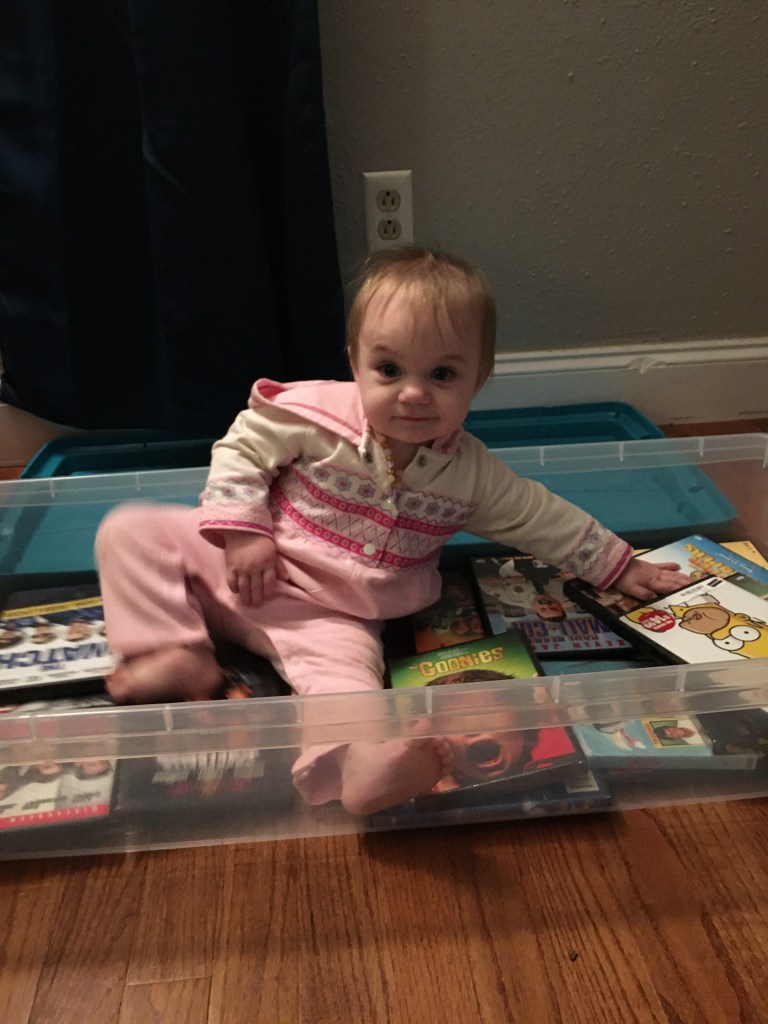
John’s parents were such a huge help by taking the older kids while we moved everything in ONE weekend! Haley, of course, did her part to help unpack in the new home 😉
**This section may be a little TMI for some** A week and a half later, I had my surgical procedure that I had been attempting to have all year. This was the third attempt due to COVID and it was finally accomplished. As many of you know, I have been dealing with ovarian cysts on and off through the years. I had a large one present during my pregnancy with Angela and I had another one burst at the end of my first trimester with Haley. Ouch! I had no idea why I was nauseous for so long into the second trimester until the technicians told me during my ultrasound. So along with having my tubes removed after Haley was born, I wanted to have my left ovary removed since that was the one that had almost all of the cysts. But as my procedure kept being delayed due to COVID, I was starting to have some strange cycles. And low and behold, after yet another ultrasound it was discovered I had yet ANOTHER cyst (4 cm) on my left ovary and endometrial thickening on my uterus. Even though having my procedure delayed was frustrating and stressful, I consider it also providence because I was able to have everything taken care of at the same time. On Wednesday, almost 3 weeks ago, I had a total hysterectomy, my left ovary and both tubes removed, and a 5cm cyst removed (yes, it had grown). I cannot express how thankful I am to be able to have that all taken care of. And believe it or not, besides being a little sore, I feel so much better now than before I had the surgery. God is good.
I am also extremely grateful to all my family that helped out during my recovery. We had my parents, mother-in-law, sister-in-law, nieces and nephews stay with us over the course of 2.5 weeks to help take care of the baby, watch and play with the older two kids, cook and clean for us. We couldn’t have made it through this time without you all.
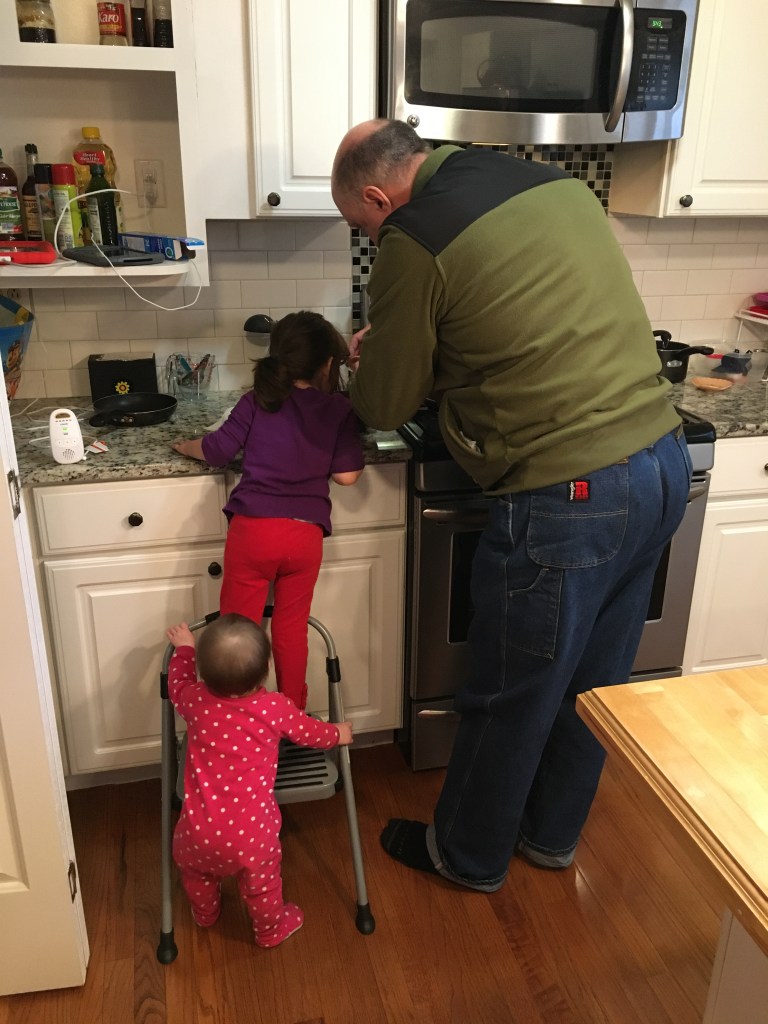
The girls helping Grandpa Kugel fix breakfast
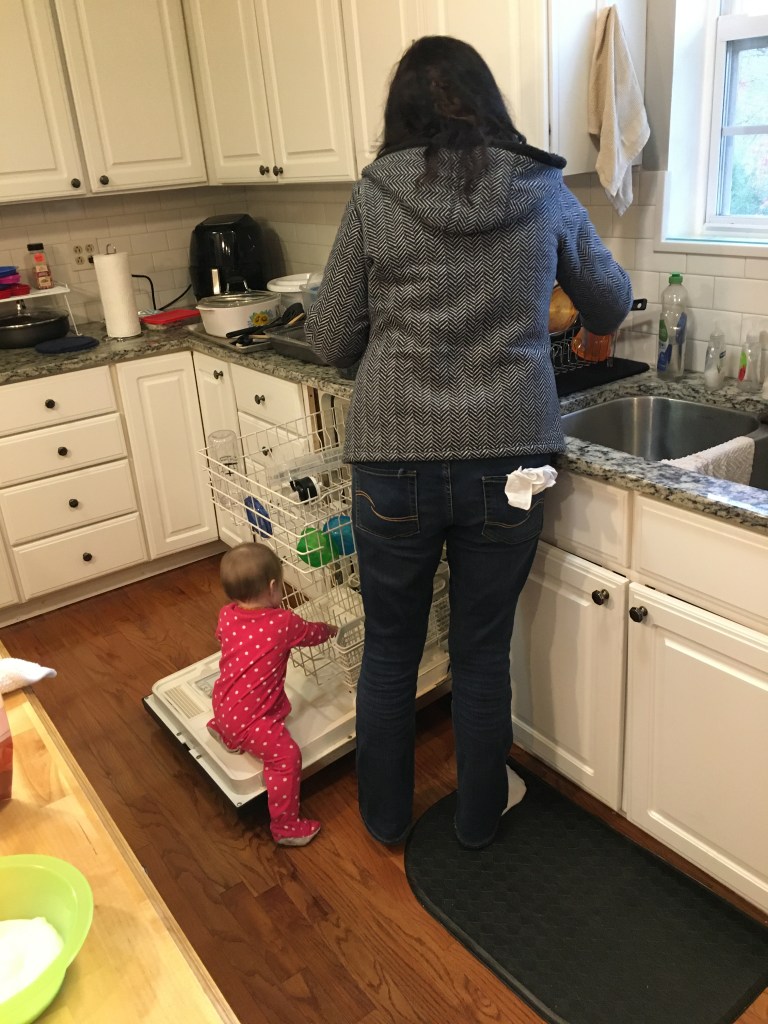
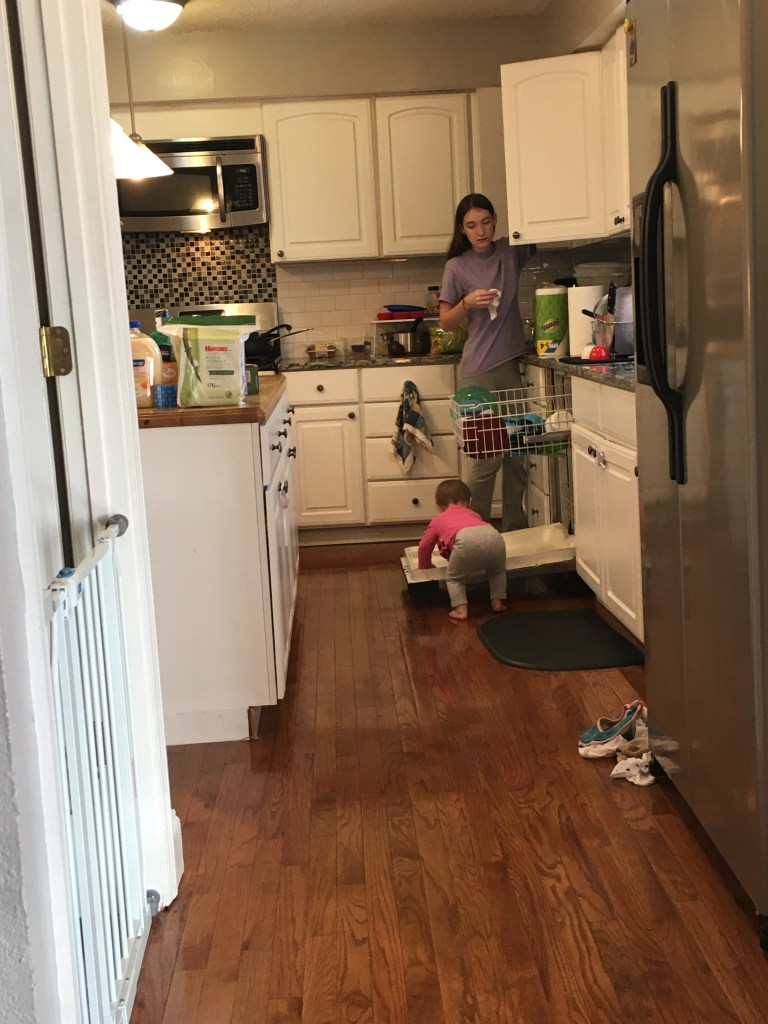
Haley helping Grandma Kugel wash dishes
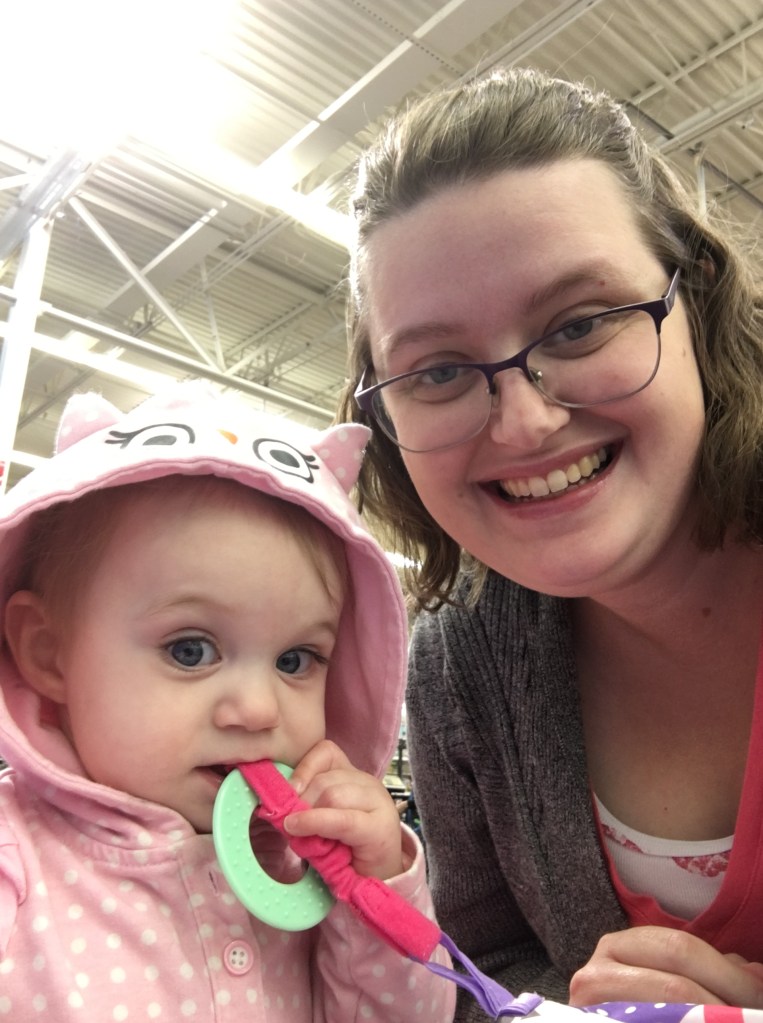
Katie took me and Haley out for my first shopping trip after my surgery
Haley helping Mollie with the dishes
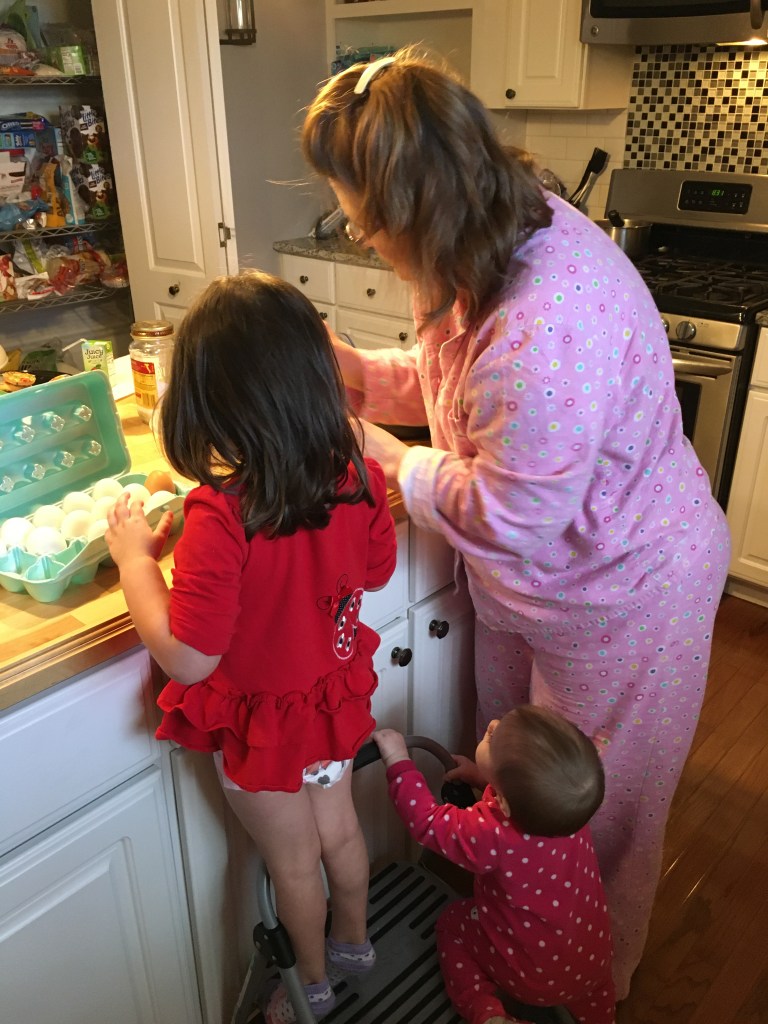
The girls helping Granny Wells fix breakfast
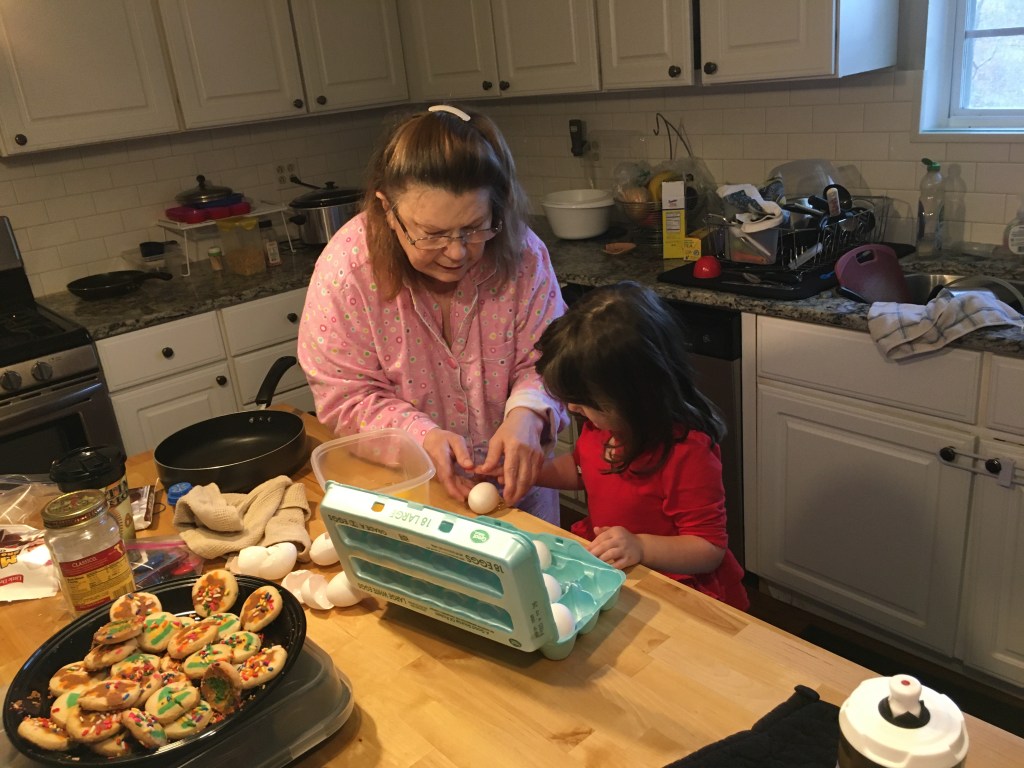
Angela helping Granny Wells crack eggs
This has certainly has been a hard year with all the changes regarding COVID and on top of that all of our own personal changes. But we have so much to be thankful for this year. A beautiful new home, wonderful friends and family, our and our kids’ health and our loving Savior.
I have so much more to share with you. This past month has been packed full of big events for us. In the next few weeks I plan to share Haley’s 11 month pictures and Jackson’s 6th birthday party! Love and hugs from us all!




 Coffee, Swings & Dinosaurs